

It is easy to promise employee retaliation protection. It is harder to back it up when the stakes are real
Retaliation has been the most frequently filed charge with the Equal Employment Opportunity Commission for seventeen years running, and in fiscal year 2024 it showed up in nearly half of every charge the agency received. Employee retaliation prevention is one of those things almost every company has on paper and far fewer have in practice. In the Ethics & Compliance Initiative’s Global Business Ethics Survey, about 46% of employees who reported misconduct said they were retaliated against for it. After more than twenty years of running anonymous reporting, that gap is the pattern we see most. Most companies do not find out whether their retaliation policy works until the day an employee actually uses it. When people decide whether to report, they mostly go off what they saw happen to the last person who did. The written policy has very little to do with it.
Why employee retaliation protection breaks down in practice
Employee Retaliation rarely looks like version training videos warn us about. Rarely does someone gets openly fired for reporting. What we see instead is a good assignment that goes to someone else with no explanation, or a manager who stops looping them in on the calls and decisions they used to be part of. None of it lands in a personnel file, which is why it works and why it is so hard to prove later.
The bigger issue is often who ends up holding the report. We have seen programs where a complaint about a manager can be opened by that same manager, who can then slow the review or work out who filed it. Protection that runs through the goodwill of the person being complained about will not hold.
Underneath both is exposure. Most reporting still asks people to attach their name before anything happens, and on a small team a confidential report is not hard to trace. When naming yourself is the risk, a promise to look after you afterward does not carry much weight.
What actually protects the people who speak up
The programs that hold up when they get tested tend to do a few of the same things, and we almost never find those things written into the policy itself.
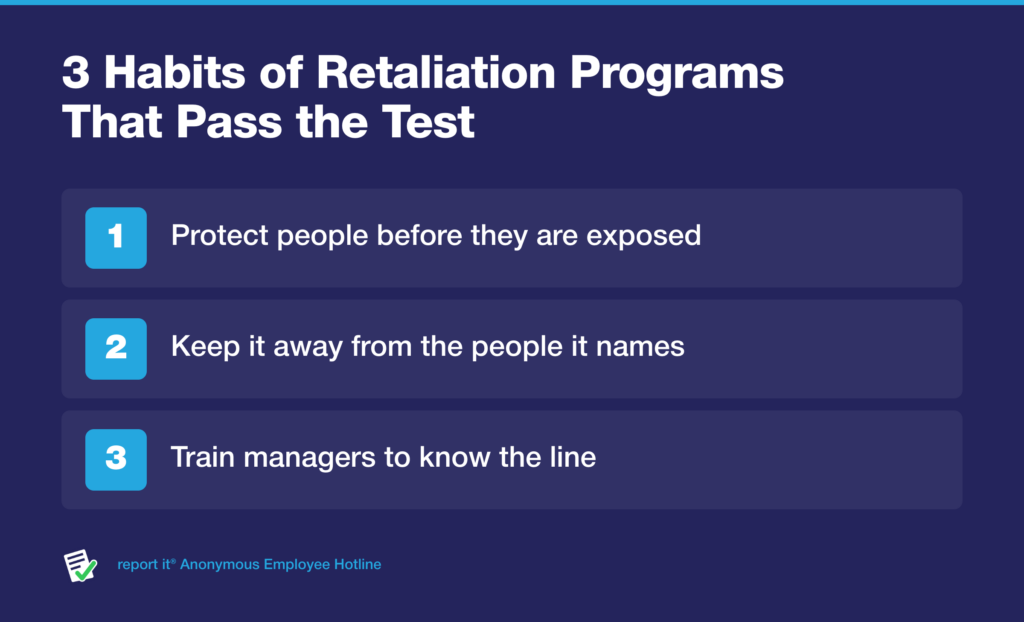
The one that matters most is that they stop asking people to expose themselves to begin with. You cannot retaliate against a name you never learned, so the protection starts before retaliation is even possible. That is the idea Report It is built around. Someone can raise a concern without ever attaching their name, from whatever device is already in their hand and in more than 130 languages, and we can still follow up with questions and updates without ever learning who they are.
A concern about a supervisor that lands on that supervisor’s desk has already leaked, so the strong programs route a complaint around the people it names and send it to someone who can actually act on it. They also keep records they would hand a regulator without flinching, because a retaliation claim months later turns the investigation file into evidence, and a file the accused could have edited is worse than none. We keep every case time-stamped and access-controlled under SOC 2, ISO 27001, and GDPR alignment for that reason.
The last habit is the managers themselves. The legal bar moved in 2024, when the Supreme Court ruled in Murray v. UBS that a whistleblower only has to show their protected report was a factor in what happened to them, at which point the burden shifts to the company. That standard runs under a lot of what SOX whistleblower requirements ask of compliance teams, and a manager who does not know where the line sits can cross it without realizing.
Backing up the promise
Trust in a program like this gets earned one resolved report at a time, which is also why we never treat anonymous reporting as a replacement for a healthy open door. The two do genuinely different jobs, something we get into in why an open door policy and anonymous reporting work together. An open door works for the people who feel comfortable using it. Plenty of people do not, usually because being seen raising the concern is the risk itself, and that is who the anonymous channel is for.
It is worth knowing how your own program would hold up before someone finds out for you. Book a demo and we will go through it together.
Frequently asked questions about employee retaliation protection
What counts as employee retaliation?
A lot more than firing, which is the version we see least. It includes a demotion or an undesirable reassignment, and far more often it is the softer treatment a personnel file never captures, like being left out of the meetings that matter or a review that slips for no clear reason. Courts take those subtler forms seriously, so they belong in manager training rather than being waved off as ordinary management.
Does an anonymous hotline actually prevent retaliation?
It removes the most common trigger, which is the reporter being identifiable in the first place. A report that never carries a name cannot be punished by name, and a channel with anonymous two-way messaging lets the investigation continue without ever unmasking the person who raised it. It does not replace good management or honest follow-through, but it closes the gap where most retaliation starts.
What is the contributing-factor standard?
It is the legal test that makes retaliation claims easier for employees to win than a lot of managers assume. A whistleblower does not have to prove the employer acted out of retaliatory intent. They only have to show that their protected report was a contributing factor in an adverse action, and from there the employer has to prove it would have taken the same step anyway.
How do you protect a reporter’s identity during an investigation?
Keep the report anonymous by default, steer it away from anyone it names, limit who can open the case file, and follow up through a channel that lets investigators ask questions without revealing the source. The whole point is that chasing down the details of a report should never become the thing that exposes the person who filed it.
How long should you keep retaliation and investigation records?
Long enough to defend the program if a claim shows up later, which for most compliance-driven records means several years. The simplest approach we see work is to align whistleblower and investigation files with the retention schedule you already run for compliance documentation, so the record still exists on the day someone asks for it.